
Abstract
Botulinum toxin A (BTXA) is considered a pharmacological agent that may provide an alternative treatment to surgery in strabismus. It can be used as both a diagnostic and therapeutic agent in various concomitant, paralytic, and restrictive disorders. The major advantage of BTXA treatment is that it is non-invasive and does not impact the patient’s chance for future surgery in case of an unfavorable response. In some selected disorders, BTXA has become the primary choice of treatment, whereas surgery is found to be more effective in others. Accumulated knowledge and experience have demonstrated that BTXA is more than merely an alternative treatment and has additional specific indications such as in unstable deviations and as an adjunct to surgery. Patients with recurrent deviations despite multiple surgeries are also good candidates for BTXA treatment. Although the major expectation is to obtain a permanent result, BTXA can also be used as a maintenance treatment. This paper mainly focuses on the current indications for the use of BTXA in strabismology, with special emphasis on ideal first-choice applications referred to as “golden indications,” within the scope of the author’s own experience with the use of BTXA over 30 years.
Keywords: Botulinum toxin, strabismus, strabismus surgery, paralytic strabismus, pharmacological treatment of strabismus
Introduction
Botulinum toxin A (BTXA) has been used for the pharmacological treatment of strabismus for over three decades. In most of the strabismus literature it is mainly regarded as an alternative to surgery depending on the choice of the strabismologist. However, accumulated knowledge and experience have demonstrated that BTXA is not only an alternative therapy but has some additional indications where surgery is not a good option., Despite a dearth of randomized controlled trials, BTXA seems to have comparable results with surgery in selected motility problems.,, In this paper, the best indications for the use of BTXA, hereafter referred to as “golden indications,” will be highlighted with literature results and the author’s own experience with the use of BTXA in strabismus over 30 years.
Conclusion
In summary, there are five indication categories of BTXA treatment in strabismus:
• Alternative to surgery and prisms in selected concomitant, restrictive, and paralytic deviations,
• A necessary additional agent in acute deviations where surgery is not an alternative,
• Good choice in surgical failures,
• Good choice to increase surgical success,
• Only choice if surgery is not an option for any reason.
In conclusion, BTXA treatment has become the primary option in certain strabismus problems. Strabismologists are recommended to be familiar with BTXA treatment, as it has gained its own non-surgical indications and has an adjunctive role in the management of challenging motility problems rather than being only an alternative treatment based on physician preference.
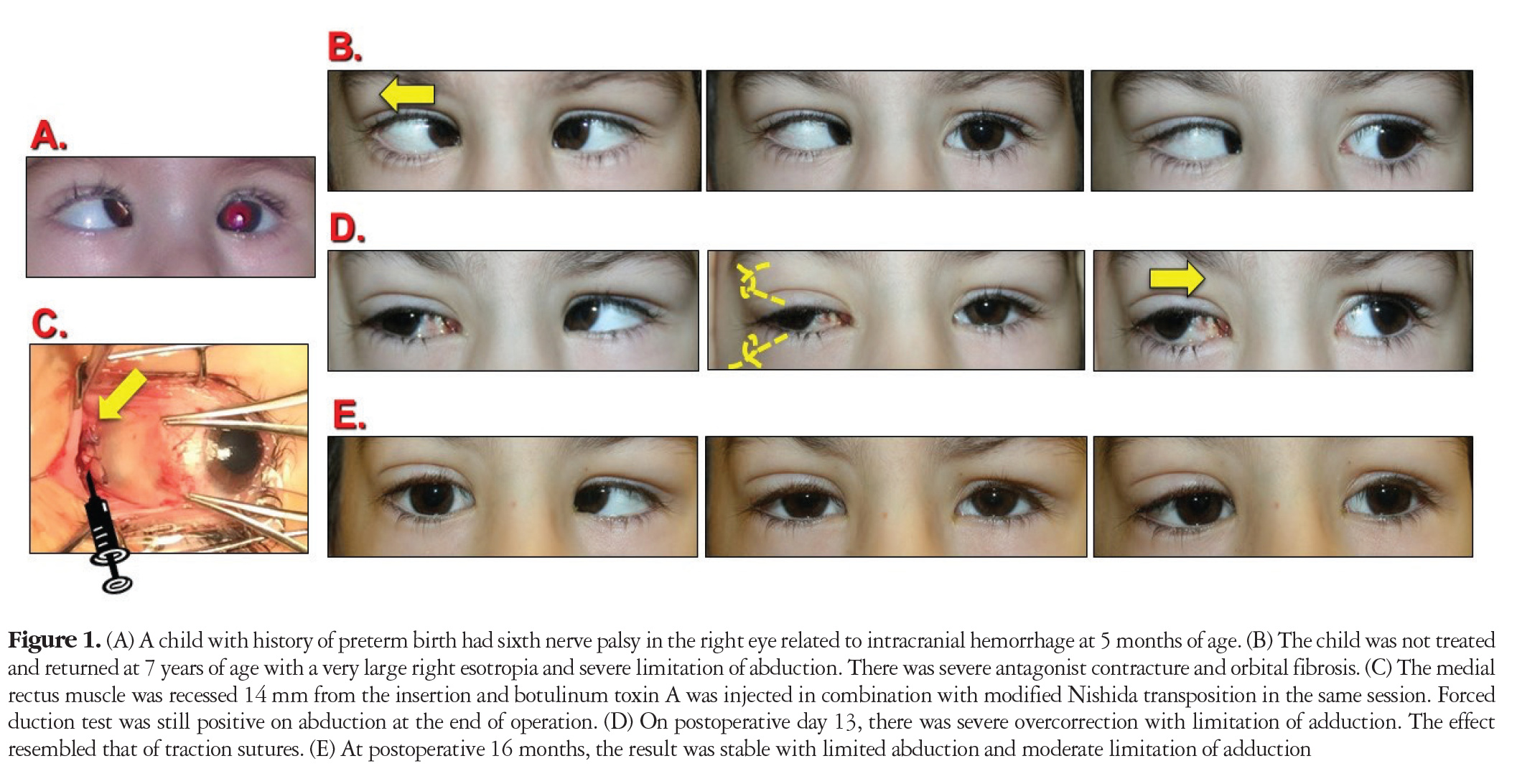
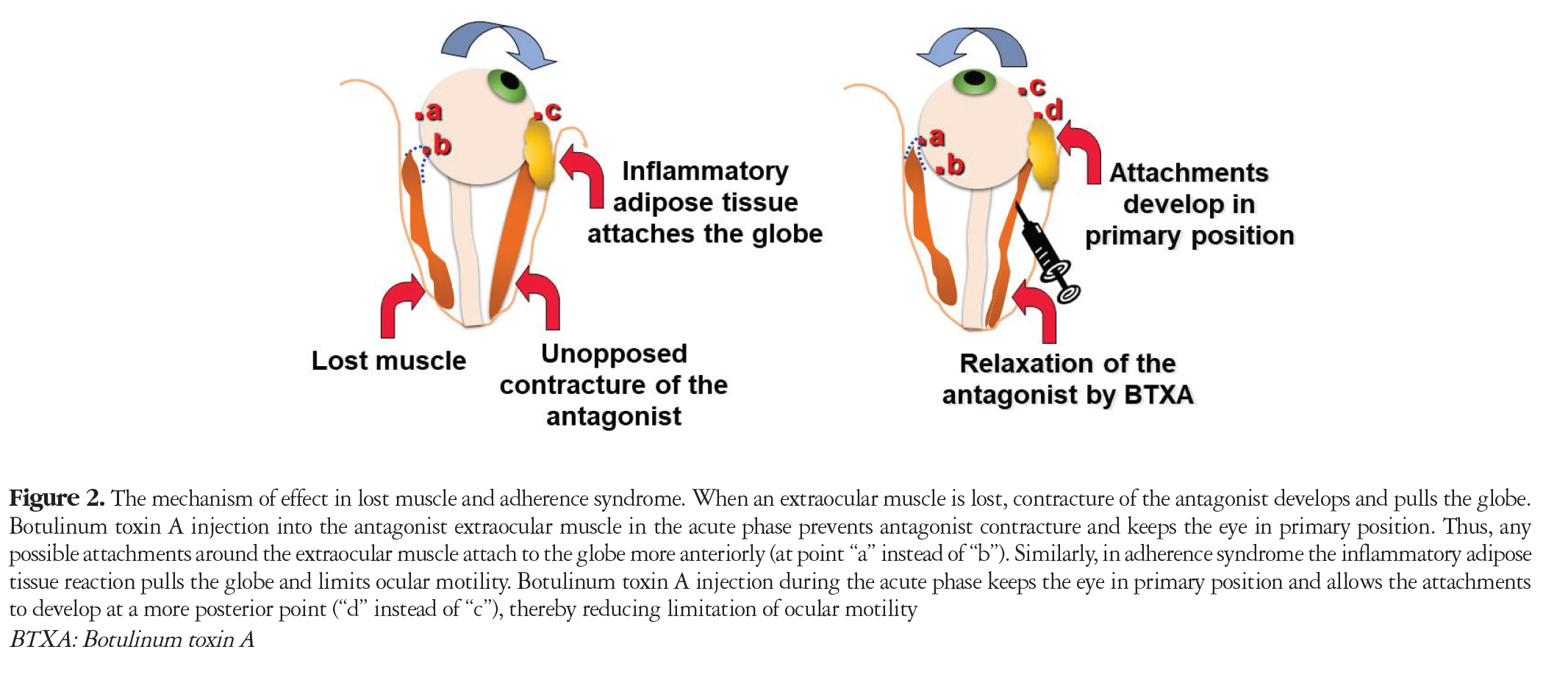
BTXA: Botulinum toxin A
References
Scott A, Özkan SB, Namgalies T. Injection of eye muscles to treat strabismus. In: Ludwig I, ed. Strabismus Surgery. 1st ed. New York: Thieme Medical Publishers; 2021:46-60.
Özkan SB. ESA Lecture - Botulinum toxin in strabismus - Just an alternative or more? In: Cioplean DE, ed. Transactions 39th Meeting of the European Strabismological Association, Porto, Portugal: Corint Books; 2017:21-30.
Binenbaum G, Chang MY, Heidary G, Morrison DG, Trivedi RH, Galvin JA, Pineles SL. Botulinum Toxin Injection for the Treatment of Strabismus: A Report by the American Academy of Ophthalmology. Ophthalmology. 2021;128:1766-1776.
Rowe FJ, Noonan CP. Botulinum toxin for the treatment of strabismus. Cochrane Database Syst Rev. 2017;3:CD006499.
Bort-Martí AR, Rowe FJ, Ruiz Sifre L, Ng SM, Bort-Martí S, Ruiz Garcia V. Botulinum toxin for the treatment of strabismus. Cochrane Database Syst Rev. 2023;3:CD006499.
Scott AB. Botulinum toxin injection of eye muscles to correct strabismus. Trans Am Ophthalmol Soc. 1981;79:734-770.
Scott AB. Botulinum toxin injection into extraocular muscles as an alternative to strabismus surgery. Ophthalmology. 1980;87:1044-1049.
Osako M, Keltner JL. Botulinum A toxin (Oculinum) in Ophthalmology. Surv Ophthalmol. 1991;36:28-46.
Scott AB. Change of Eye muscle sarcomers according to eye position. J Pediatr Ophthalmol Strabismus. 1994;31:85-88.
Kranjc BS, Sketelj J, D’Albis A, Erzen I. Long-term changes in myosin heavy chain composition after botulinum toxin a injection into rat medial rectus muscle. Invest Ophthalmol Vis Sci. 2001;42:3158-3164.
Croes SA, Baryshnikova LM, Kaluskar SS, von Bartheld CS. Acute and long-term effects of botulinum neurotoxin on the function and structure of developing extraocular muscles. Neurobiol Dis. 2007;25:649-664.
Ozkan SB, Kir E, Dayanir V, Dündar SO. Botulinum toxin A in the treatment of adherence syndrome. Ophthalmic Surg Lasers Imaging. 2003;34:391-395.
Sener EC, Sanaç AS. Efficacy and complications of dose increments of botulinum toxin-A in the treatment of horizontal comitant strabismus. Eye (Lond). 2000;14:873-878.
Niyaz L, Yeter V, Beldagli C. Success rates of botulinum toxin in different types of strabismus and dose effect. Can J Ophthalmol. 2023;58:239-244.
Özkan SB. Pearls and pitfalls in surgical management of paralytic strabismus. In: Lorenz B, Brodsky M, eds. Essentials of Ophthalmology - Pediatric Ophthalmology, Neuro-ophthalmology, Genetics. Springer- Verlag Berlin Heidelberg; 2010:195-206.
Ansons AM, Davis. Diagnosis and Management of Ocular Motility Disorders. Oxford: Blackwell Science Ltd; 2001:143-162.
Khan J, Kumar I, Marsh IB. Botulinum toxin injection for postoperative diplopia testing in adult strabismus. J AAPOS. 2008;12:46-48.
Pratt Johnson JA. Fusion ability lost and regained in visual adults. Graefes Arch Clin Exp Ophthalmol. 1988;226:111-112.
Pratt-Johnson JA, Tillson G. Intractable diplopia after vision restoration in unilateral cataract. Am J Ophthalmol. 1989;107:23-26.
Digout LG, Awad AH. Restoration of binocular single vision after long term fusion disruption. J AAPOS. 2003;7:185-189.
Hakin KN, Lee JP. Binocular diplopia in unilateral aphakia: The role of botulinum toxin. Eye (Lond). 1991;5:447-450.
Murthy R, Kesarwani S. Botulinum toxin in the management of acquired motor fusion deficiency. Indian J Ophthalmol. 2009;57:463-464.
Özkan SB, Akyüz Ünsal Aİ. Role of botulinum toxin A in treatment of intractable diplopia. J AAPOS. 2017;21:354-356.
Véronneau-Troutman S. Fresnel prisms and their effects on visual acuity and binocularity. Trans Am Ophthalmol Soc. 1978;76:610-653.
Wright D, Firth A, Buckley D. Comparison of the visual effects of Fresnel prisms in normal and amblyopic eyes. J AAPOS. 2008;12:482-486.
Gardner R, Dawson EL, Adams GG, Lee JP. Long-term management of strabismus with multiple repeated injections of botulinum toxin. J AAPOS. 2008;12:569-575.
Horgan SE, Lee JP, Bruce C. The long term use of botulinum toxin for adult strabismus. J Pediatr Ophthalmol Strabismus. 1998;35:44-45.
Magoon E, Scott AB. Botulinum toxin chemodenervation in infants and children: an alternative to incisional strabismus surgery. J Pediatr. 1987;110:719-722.
Scott AB, Magoon EH, McNeer KW, Stager DR. Botulinum treatment of childhood strabismus. Ophthalmology. 1990;97:1434-1438.
Rayner SA, Hollick EJ, Lee JP. Botulinum toxin in childhood strabismus. Strabismus. 1999;7:103-111.
Gomez de Liano R, Jimenez Gonzalez R, Piedrahita E, Zuloaga P. BT in small angle esotropia. In: Özkan SB, ed. Advances in Strabismus, Proceedings of the XII. th Meeting of the International Strabismological Association. Ankara, Turkey: Kyoto, Rotatıp Publisher; 2015:186-190.
Gomez de Liano R, Rodriguez JM, Gomez de Liano P, De Andres ML. Botulinum toxin in esotropic patients up to 3 years of age. In: Lennerstrand G, ed. Update on Strabismus and Pediatric Ophthalmology. Baco Raton, Fla: CRC Press; 1996:25.
McNeer KW, Tucker MG, Spencer RF. Botulinum toxin management of essential infantile esotropia in children. Arch Ophthalmol. 1997;115:1411-1418.
Baggesen K, Arnljot HM. Treatment of congenital esotropia with botulinum toxin type A. Acta Ophthalmol. 2011;89:484-488.
Gursoy H, Basmak H, Sahin A, Yildirim N, Aydin Y, Colak E. Long-term follow-up of bilateral botulinum toxin injections versus bilateral recessions of the medial rectus muscles for treatment of infantile esotropia. J AAPOS. 2012;16:269-273.
Campos EC, Schiavi C, Bellusci C. Critical age of botulinum toxin treatment in essential infantile esotropia. J Pediatr Ophthalmol Strabismus. 2000;37:354-355.
de Alba Campomanes AG, Binenbaum G, Campomanes Eguiarte G. Comparison of botulinum toxin with surgery as primary treatment for infantile esotropia. J AAPOS. 2010;14:111-116.
Ameri A, Mirmohammadsadeghi A, Makateb A, Bazvand F, Hosseini S. Clinical outcomes of botulinum toxin injection in patients with cerebral palsy and esotropia. Strabismus. 2015;23:8-13.
Mangan MS, Basar E. Comparison of the Efficiency of the Botulinum Toxin for the Treatment of Esotropia in Children with and without Neurological Disease and/or Prematurity. J Binocul Vis Ocul Motil. 2020;70:163-169.
Tugcu B, Araz-Ersan B, Özkan SB. Botulinum toxin A for the treatment of strabismus in children with neurological impairment. Arq Bras Oftalmol. 2023. S0004-27492023005002301. Online ahead of print.
Spencer RF, Tucker MG, Choi RY, McNeer KW. Botulinum toxin management of childhood intermittent exotropia. Ophthalmology. 1997;104:1762-1767.
Li Y, Wu X. Observation of botulinum toxin A management in childhood with intermittent exotropia. Zhonghua Yan Ke Za Zhi. 2008;44:967-971.
Su H, Fu J, Wu X, Sun A, Zhao B, Hong J. Comparison of Botulinum toxin type A with surgery for the treatment of intermittent exotropia in children. BMC Ophthalmol. 2022;22:53.
Wan MJ, Mantagos IS, Shah AS, Kazlas M, Hunter DG. Comparison of Botulinum Toxin With Surgery for the Treatment of Acute-Onset Comitant Esotropia in Children. Am J Ophthalmol. 2017;176:33-39.
Shi M, Zhou Y, Qin A, Cheng J, Ren H. Treatment of acute acquired concomitant esotropia. BMC Ophthalmol. 2021;21:9.
Huang X, Meng Y, Hu X, Zhao Y, Ye M, Yi B, Zhou L. The Effect of Different Treatment Methods on Acute Acquired Concomitant Esotropia. Comput Math Methods Med. 2022;2022:5001594.
Song D, Qian J, Chen Z. Efficacy of botulinum toxin injecton versusbilateral medial rectus recession for comitant esotropia: a meta-analysis. Graefes Arch Clin Exp Ophthalmol. 2023;261:1247-1256.
Suwannaraj S, Rojanasaksothron C, Methapisittikul Y, Wongwai P, Yospaiboon Y. Botulinum Toxin Injection versus Extraocular Muscle Surgery for Acute Acquired Comitant Esotropia. Clin Ophthalmol. 2023;17:413-420.
Jones A, Jain S. Botulinum toxin: a novel treatment for pediatric cyclic esotropia. J AAPOS. 2014;18:614-615.
Wipf M, Bok-Beaube C, Palmowski-Wolfe A. Botulinum Toxin for the Treatment of Cyclic Strabismus in Children: Three Case Reports. Klin Monbl Augenheilkd. 2018;235:465-468.
Akyuz Unsal AI, Özkan SB, Ziylan S. Role of Botulinum Toxin Type A in Cyclic Esotropia: A Long-Term Follow-up. J Pediatr Ophthalmol Strabismus. 2019;56:360-364.
Metz HS, Masow M. Botulinum toxin treatment of acute sixth and third nerve palsy. Graefe’s Arch Clin Exp Ophthalmol. 1988;226:141-144.
Murray AD. Early botulinum toxin treatment of acute sixth nerve palsy. Eye (Lond). 1991;5:45-47.
Lozano-Pratt A, Estanol B. Treatment of acute paralysis of the fourth cranial nerve by botulinum toxin A chemodenervation. Binocul Vis Strabismus Q. 1994;9:155-158.
Talebnejad MR, Tahamtan M, Nowroozzadeh MH. Botulinum Toxin Injection for Treatment of Acute Traumatic Superior Oblique Muscle Palsy. J Ophthalmic Vis Res. 2015;10:263-267.
Lee J, Harris S, Cohen J, Cooper K, MacEwen C, Jones S. Results of a prospective randomized trial of botulinum toxin therapy in acute unilateral sixth nerve palsy. J Pediatr Ophthalmol Strabismus. 1994;31:283-286.
Holmes JM, Beck RW, Kip KE, Droste PJ, Leske DA. Botulinum toxin treatment versus conservative management in acute traumatic sixth nerve palsy or paresis. J AAPOS. 2000;4:145-149.
Hung HL, Kao LY, Sun MH. Botulinum toxin treatment for acute traumatic complete sixth nerve palsy. Eye (Lond). 2005;19:337-341.
Repka MX, Lam GC, Morrison NA. The efficacy of botulinum neurotoxin A for the treatment of complete and partially recovered chronic sixth nerve palsy. J Pediatr Ophthalmol Strabismus. 1994;31:79-84.
Hernandez-García E, Burgos-Blasco B, Özkan SB, Sharma P, Aguilar Ruiz A, Dominguez DP, Lai YH, Carreño Cevallos D, Molinari A, Gómez-de-Liaño R. A comparative multicentric long-term study of un-augmented modified Nishida procedure vs augmentation in unilateral sixth nerve palsy. Eye (Lond). 2023;37:170-175.
Pineles SL, Chang MY, Holmes JM, Kekunnaya R, Özkan SB, Velez FG. Innovative techniques for the treatment of adult strabismus. J AAPOS. 2019;23:132-139.
Bagheri A, Eshaghi M. Botulinum toxin injection of the inferior oblique muscle for the treatment of superior oblique muscle palsy. J AAPOS. 2006;10:385-388.
Merino P, Gómez de Liaño P, García C, Bartolomé G, Rodríguez C, De Juan L. Parálisis bilateral IV par y toxina botulínica [Bilateral superior oblique palsy and botulinum toxin]. Arch Soc Esp Oftalmol. 2004;79:119-123.
Garnham L, Lawson JM, O’Neill D, Lee JP. Botulinum toxin in fourth nerve palsies. Aust N Z J Ophthalmol. 1997;25:31-35.
Özkan SB, Akyuz Unsal AI, Kagnici DB. The efficacy of superior rectus recession with simultaneous inferior oblique disinsertion on superior oblique palsy with superior rectus contracture. Strabismus. 2019;27:16-23.
Özkan SB, Balıca F. Botulinum toxin injection of superior rectus muscle in superior oblique palsy with large vertical deviation. In: Cioplean DE, ed. Transactions 38th Meeting of the European Strabismological Association, Budapest: Hungary; 2016:117-119.
Newman NJ, Lambert SR. Botulinum toxin treatment of supranuclear ocular motility disorders. Neurology. 1992;42:1391-1393.
Kipioti A, Taylor RH. Botulinum toxin treatment of “one and a half syndrome”. Br J Ophthalmol 2003;87:918-919.
Murthy R, Dawson E, Khan S, Adams GG, Lee J. Botulinum toxin in the management of internuclear ophthalmoplegia. J AAPOS. 2007;11:456-459.
Dawson EL, Maino A, Lee JP. Diagnostic use of botulinum toxin in patients with Duane syndrome. Strabismus. 2010;18:21-23.
Maya JF, de Liaño RG, Catalán MR, Rayward O. Botulinum toxin treatment in patients up to 3 years of age who have esotropic Duane retraction syndrome. Strabismus. 2013;21;4-7.
Sener EC, Yilmaz PT, Fatihoglu ÖU. Botulinum toxin-A injection in esotropic Duane syndrome patients up to 2 years of age. J AAPOS. 2019;23:25.
Gair EJ, Lee JP, Khoo BK, Maurino V. What is the role of botulinum toxin in the treatment of dysthyroid strabismus? J AAPOS. 1999;3:272-274.
Bessant DA, Lee JP. Management of Strabismus due to orbital myositis. Eye (Lond). 1995;9:558-563.
Lee JP, Page B, Lipton J. Treatment of strabismus after retinal detachment surgery with botulinum neurotoxin A. Eye (Lond). 1991;5:451-455.
Özkan SB. Restrictive problems related to strabismus surgery. Taiwan J Ophthalmol. 2016;6:3:102-107.
Ozkan SB, Topaloğlu A, Aydin S. The role of botulinum toxin A in augmentation of the effect of recession and/or resection surgery. J AAPOSi. 2006;10:124-127.
Khan AO. Two horizontal eye muscle surgery combined with botulinum toxin for the treatment of very large angle esotropia. A pilot study. Binocul Vis Strabismus Q. 2005;20:15-20.
Lueder GT, Galli M, Tychsen L, Yildirim C, Pegado V. Long-term results of botulinum toxin-augmented medial rectus recessions for large-angle infantile esotropia. Am J Ophthalmol. 2012;153:560-563.
Stager DR, Weakley DR Jr, Everett M, Birch EE. Delayed consecutive exotropia following 7-millimeter bilateral medial rectus recession for congenital esotropia. J Pediatr Ophthalmol Strabismus. 1994;31:147-150.
Wan MJ, Gilbert A, Kazlas M, Wu C, Mantagos IS, Hunter DG, Shah AS. The Effect of Botulinum Toxin Augmentation on Strabismus Surgery for Large-Angle Infantile Esotropia. Am J Ophthalmol. 2018;189:160-165.
Tuğcu B, Sönmezay E, Nuhoğlu F, Özdemir H, Özkan SB. Botulinum toxin as an adjunct to monocular recession-resection surgery for large-angle sensory strabismus. J AAPOS. 2017;21:117-120.
Dawson EL, Marshman WE, Lee JP. Role of botulinum toxin A in surgically overcorrected exotropia. J AAPOS. 1999;3:269-271.
Özkan SB. Role of Botulinum toxin to rescue failed strabismus surgery. In: Özkan SB (ed) Update on Strabismology, Ankara, Rotatıp Publishers, Proceedings of the XIth Meeting of the International Strabismological Association, İstanbul, Rotatıp Publisher, Ankara, Turkey, 2010:37-41.
Tejedor J, Rodriguez JM. Retreatment of children after surgery for acquired esotropia: reoperation versus botulinum injection. Br J Ophthalmol. 1998;82:110-114.
Tejedor J, Rodrigez JM. Early retreatment of infantile esotropia: comparison of reoperation and botulinum toxin. Br J Ophthalmol. 1999;83:783-787.
Murray AD. Slipped and lost muscles and other tales of the unexpected. Philip Knapp Lecture. J AAPOS. 1998;2:133-143.
Özkan SB. Lost muscle in strabismus surgery - How to handle the problem? DOS Times. 2017;23;52-55.
Rowe F, Noonan C. Complications of botulinum toxin a and their adverse effects. Strabismus. 2009;17:139-142.
Chen J, Deng D, Zhong H, Lin X, Kang Y, Wu H, Yan J, Mai G. Botulinum toxin injections combined with or without sodium hyaluronate in the absence of electromyography for the treatment of infantile esotropia: a pilot study. Eye (Lond). 2013;27:382-386.
Pediatric Eye Disease Investigator Group; Christiansen SP, Chandler DL, Lee KA, Superstein R, de Alba Campomanes A, Bothun ED, Morin J, Wallace DK, Kraker RT. Tonic pupil after botulinum toxin-A injection for treatment of esotropia in children. J AAPOS. 2016;20:78-81.
Kutluk S, Akar S, Topçu M, Kural G. Effect of botulinum toxin injections into rabbit eye. Strabismus. 1999;7:221-226.